A Hindi comedy script does not need to sound like a translated English essay. Start with how you tell a friend the story. Which words would you naturally leave in English? Which Hindi phrase carries the attitude? Keep those decisions in the draft.
This is an original practice example about office meetings. It is a writing exercise, not a clip of a tested Hindi performance.
1. Pick a small contradiction.
“Office life” is too broad to give the line a direction. “A meeting to reduce meetings creates more meetings” gives you something to exaggerate. Write the situation first, then decide whether your character is annoyed, impressed or completely resigned.
HINGLISH DRAFT
Office mein meetings kam karne ke liye meeting rakhi.
Uske baad teen follow-up meetings aa gayi.
Problem solve nahi hui. Uski team ban gayi.
What turns: The listener expects the problem to be reduced. Instead, the organisation gives the problem more people and more meetings.
HINDI DRAFT
दफ़्तर में बैठकें कम करने के लिए एक बैठक बुलाई।
उसके बाद तीन और बैठकों का बुलावा आ गया।
समस्या सुलझी नहीं। उसकी टीम बन गई।
The Hindi and Hinglish drafts are alternatives. Choose the wording that matches your speech; neither needs to be performed word for word.
2. Let the last phrase do the work.
Read the last line aloud without explaining it afterwards. Then try a different ending. In Hinglish, a familiar office phrase may carry the joke more quickly than a formal translation.
AN ALTERNATIVE TAG
Ab problem ka bhi manager hai.
अब समस्या का भी मैनेजर है।
Try the tag only after the audience has understood the first turn. If it merely repeats the same point, cut it. Pause length and word choice need rehearsal, not a fixed formula.
3. Keep writing and pronunciation separate.
Roman letters can hide the sound you intended. “Main” can mean the Hindi मैं, or the English word “main”. A generated voice needs context to distinguish them.
ILLUSTRATION · NOT AN AUDIO DEMO
You write: Main meeting mein bola: let's keep it short.
Spoken preparation: मैं meeting में बोला: let's keep it short.
Your captions can keep the writing you chose while the video model receives a prepared spoken form.
In crushedwithit, inspect “Said as”, check names and uncertain words, and save a pronunciation correction when needed. It helps prepare future instructions; it does not guarantee that the model will pronounce every line correctly.
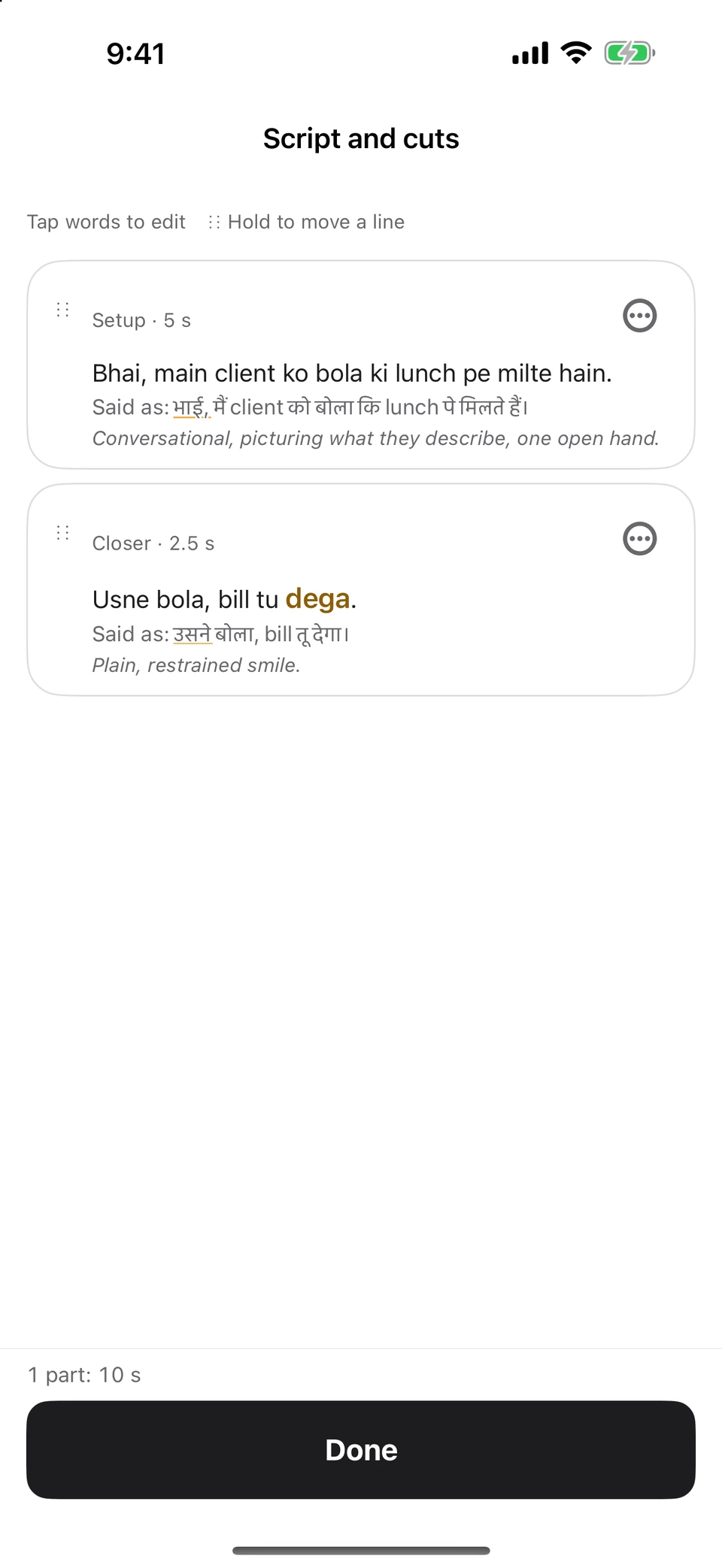
4. Hear the actual result.
For a camera performance, record a rehearsal and listen without looking at the text. For a Personal Double video, review the generated speech and the joins between parts. Pay particular attention to names, numbers and language switches.
- Keep a natural English word if you would use it in conversation.
- Rewrite a stiff phrase before trying increasingly elaborate phonetic spellings.
- Check the spoken output separately from the captions.
- Ask a fluent speaker to listen when writing outside your strongest language.
5. Rehearse the thought, then the landing.
An English practice line in the native app.
What happens in this recording
The rehearsal screen shows a cue, switches to a punch card and reveals the ending of the line. It is a silent interface demonstration, not a spoken performance or a Hindi audio sample.
The recording above shows an English practice card in the actual app. It demonstrates the rehearsal interface, not Hindi speech generation or a measured language-quality result.
Write a short cue for the idea and practise the ending aloud. If the language switch slows the line down, move it. The right version is the one you can deliver clearly and naturally.
Language choices: English, Hinglish, Hindi, Telugu, Tamil, Kannada, Marathi and Punjabi are available for writing and reels. This does not mean every screen is translated. Dictation and live recognition depend on device language models; Hinglish uses an Indian English fallback. Generated delivery varies by language and line.